EtherHiding Under the Hood: On-Chain Forensics Beyond the Public Disclosure
Reverse-engineering a RedLine+EtherHiding sample uncovers an undocumented anti-sandbox technique, an AES-256 key that unlocks the malware's on-chain C2 contract, and a year of C2 IP rotations recovered directly from BNB Smart Chain.
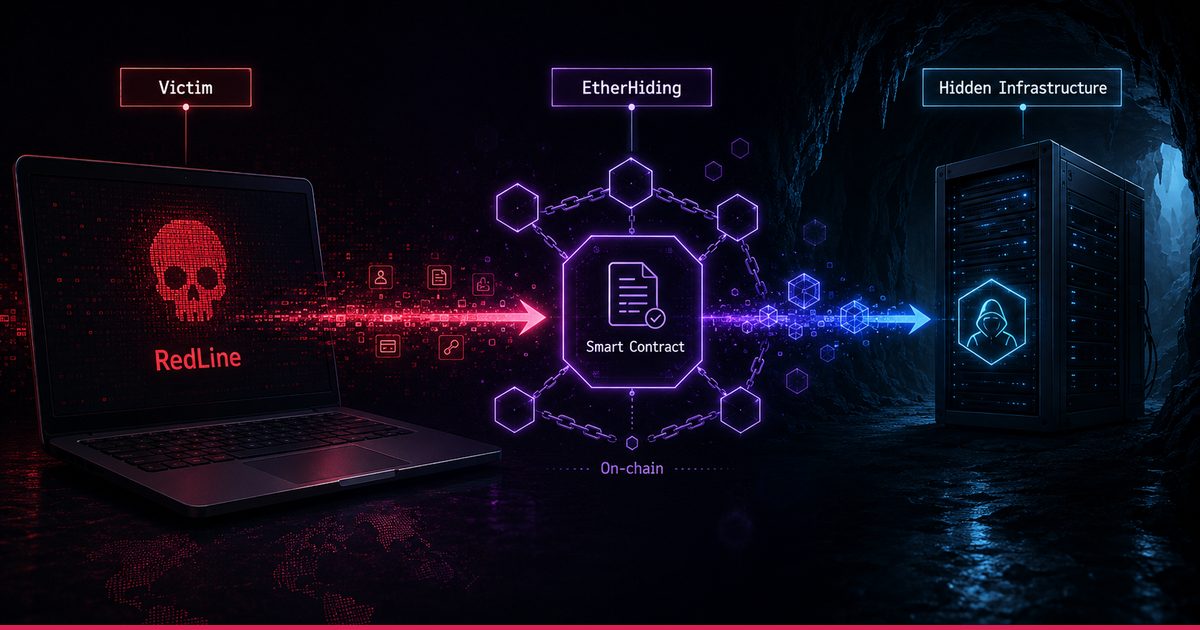
Key takeaways
- While researching on the Ehterhiding technique used in the wild, we found 6 particularly interesting RedLine samples leveraging EtherHiding, submitted to Filescan.io Community on March 25, 2026. Reverse-engineering one of them (
5ead45bc83c4fee8...) uncovered four stacked evasion/delivery layers, one of which we haven’t seen documented elsewhere. - That novel layer strips the native PE import table and
_CorExeMainbootstrap stub entirely, forcing the payload to be reflectively loaded rather than run directly , used as an anti-sandbox trick that defeats naive automated detonation. - The sample never hardcodes its C2, it AES-256-CBC decrypts a BSC smart-contract address at runtime, then reads the actual C2 value from that contract via a read-only
eth_call. We recovered the AES key and decrypted both values ourselves. - The resolver contract (Contract A) has been live since June 2025. Its full on-chain transaction history (all 20
update()calls, from deployment to its most recent write) decrypts cleanly, giving us a year-long record of C2 IP rotation, not just the single IP active when the sample was submitted to Filescan.io. - We found 122 other BSC contracts sharing Contract A’s exact bytecode template, though the recovered AES key doesn’t decrypt their traffic, meaning key material is scoped per contract or per operator sub-cluster rather than shared across operators.
- Passive analysis on the 10 rotated C2 IPs show the rotation isn’t random: two hosting providers, AS216071 (VDSina) and AS202051 (NETGRID HOST LTD), account for 7 of the 10. The finding of additional IP addresses could hint a timeline of this activity cluster, suggesting a duration of slightly more than a year at the time of writing.
Last week we published a research on a ClickFix campaign that used the EtherHiding technique and was most likely related to the ErrTraffic MaaS platform (see article), while there are not connections to ErrTraffic’s MaaS, this new cluster also exposes a wide well-defined infrastructure for multiple persistent-in-time campaigns.
During the research we identified over 100 PE samples in the Filescan.io Community corpus. Although they were unrelated to last week’s article, they carried blockchain RPC C2 signals, a communication protocol that acts as a bridge, enabling applications such as wallets and decentralized applications (dApps) to communicate with the nodes of a blockchain network.
Six of these samples caught our attention for their evasion layers. In this article we share our analysis on this cluster of samples.
Reverse-engineering the “broken” samples
Six Redline+EtherHiding samples were submitted to Filescan.io Community on March 25, 2026. Initially it stood out the fact that these six samples failed to execute as normal PEs in our labs (hence failing in any traditional sandbox). A deeper analysis showed a genuinely interesting finding: this sample stacks four independent evasion/delivery layers, which, as far as we know, haven’t been reported before, at the time of our research.
The four evasion layers
| Layer | Origin | What it does | Novelty |
|---|---|---|---|
| 1. Native PE import-table stripping | Custom crypter/obfuscator step | The native Import Address Table (IAT) and _CorExeMain bootstrap stub are physically absent from the file, removed entirely (zero hits anywhere in the binary for the strings _CorExeMain, mscoree.dll, _CorDllMain). Though, the managed .NET metadata (CLR header, IL, entry point) is 100% intact. Because of this, Windows refuses to launch the file natively (“This application could not be started”), while dnSpy and other CLR-metadata-only tools open it without complaint. This forces the payload to be reflectively loaded (Assembly.Load() + payload invocation) by a separate stager rather than run directly (i.e. double click on the sample), an anti-sandbox technique that defeats naive “just run it” automated detonation.Some less sophisticated dotnet PE libraries in fact may fail to load/parse such tampered PEs. | Novel. No named, documented .NET obfuscator or commercial protector that we know of advertises native import-table stripping as an anti analysis feature. Legitimate x64-only .NET assemblies do have a genuinely absent import table, but they also have AddressOfEntryPoint == 0. This sample has a non-zero entry point that resolves into dead zero-padding (a bogus leftover value, not a clean absence) which points to deliberate post-build tampering. |
| 2. ConfuserEx variant obfuscation | Off-the-shelf protector variant | Many fingerprints allowed us to identify this layer as a ConfuserEx variant. However the string protection diferred from the traditional ConfuserEx single-byte-xoring of strings. This variant implemented an additional evasion effort by storing the encrypted string table as an embedded dotnet resource, decrypted on demand, resulting in an particular characteristic of this variant which we have not seen documented before. Some additional ConfuserEx indicators are: - Control-flow flattening - “Reference proxy” indirect dispatch (calls resolved at runtime via Module.ResolveMethod(...).MethodHandle.GetFunctionPointer() into static function-pointer tables and invoked with IL calli instead of call/callvirt, invisible to static call-graph tools)- Disguised constant literals ( Type.EmptyTypes.Length, always 0, used as a fake variable)- Metadata stream renamed #- instead of the standard #~ plus four bogus/reserved metadata table bits set to make naive parsers choke. | While ConfuserEx is a widely known, well-documented protector family (unmaintained since 2016) many forks and variants keep popping up. We were not able to link this variant relying on a dotnet resource for the strings protection to an existing fork or documented variation. |
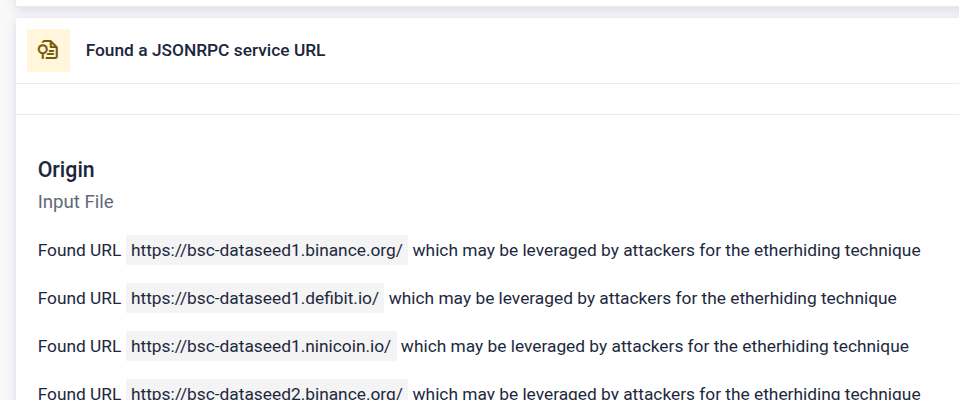
| 3. EtherHiding C2 resolver, with AES-256-CBC contract-address decryption | Custom application code, novel add-on | The sample never hardcodes a C2 address. At runtime it assembles and sends a JSON-RPC eth_call to public BSC seed nodes (bsc-dataseed{1-4}.binance.org, .defibit.io, .ninicoin.io) invoking a smart contract’s get() method (selector 0x6d4ce63c = keccak256("get()")[:4]). The contract address itself is not stored in plaintext in the binary, it is AES-256-CBC encrypted in the ConfuserEx string table, decrypted at runtime by a small custom class. Both the AES key and the ciphertext are retrieved from the encrypted string table hidden as a dotnet resource. | Novel pairing. ConfuserEx never generates networking or blockchain code, it only supplies the string-hiding wrapper around the C2 constants. Classic RedLine ships its C2 as a hardcoded Base64 config blob over WCF/SOAP. These samples, reading it from a BSC contract replaces that hardcoded step with an operator-mutable, takedown-resistant on-chain lookup. This is custom code grafted in front of a RedLine-family payload and after ConfuserEx variant protection layer. |
| 4. RedLine-lineage stealer payload | Commodity stealer | The dead-code sweep recovered RedLine’s full data-contract model near-verbatim: ScanResult, ScanDetails, ScannedFile/Cookie, ScanningArgs, BrowserVersion, Autofill, OsCrypt/LocalState, plus a StealerSettingConfigParce config struct toggling discord/files/ftp/steam/telegram/vpn/grabber modules. | Not novel, commodity malware. However, this schema is shared with RedLine’s close relative META Stealer, a near-identical rebrand. The exact brand can’t be proven from static evidence alone. |
The AES decryption in detail
The resolver contract address is first retrieved as a base64 ciphertext from the encrypted strings table, along with the AES key used to decrypt it:
- Key:
mj.a = Convert.FromBase64String(xk.i). The AES-256 key is simply the raw Base64 decode of one string-table entry (xk.i), with no hashing or KDF applied. There’s no key-stretching step to reverse. The “key derivation function” (sp(mj)) just returns the raw bytes. - Cipher: AES-256-CBC, PKCS7 padding, IV = the first 16 bytes of the encrypted blob, ciphertext = everything after.
- Recovered values:
| Field | Value |
|---|---|
| AES-256 key (base64) | FmWKbgtJCRZw/RjxieH+DO4n+CSTb/agdxOiBu3clDY= |
| AES-256 key (hex) | 16658a6e0b49091670fd18f189e1fe0cee27f824936ff6a07713a206eddc9436 |
| IV (hex) | 541dd0207d92c0e7d2c6138417559b2f |
| Decrypted plaintext | 0x67b4af41467a51e0816752a6b223c7c55ae71957 |
Decryption succeeded with valid PKCS7 padding on the first attempt, confirming the key/IV/scheme are correct, and the same AES key is reused a second time to decrypt the actual C2 value returned by the contract’s get() call. So, the retrieved AES key first decrypts the hardcoded BSC smart-contract address (the EtherHiding resolver contract), and the same key is used to decrypt the queried info. This adds additional obstacle for researchers monitoring this activity, since the AES key needs to be obtained from a live sample, in order to decrypt the information stored in a smart contract, even after a successful hunt of additional smart contracts abused for the same campaign.
The BSC contract infrastructure
The decrypted address, 0x67b4af41467a51e0816752a6b223c7c55ae71957 (Contract A) is operated by the wallet 0x9bD32c5d9fe24cd70fe5532c484db50f5a6cCcf5.
After the research, we created a config extractor for Filescan.io (among other additional detections) to catch malware samples using the EtherHiding technique. We resubmitted the other five samples to check the contracts and RPC endpoints and found out they all have the same configuration.
Check or monitor for more samples using the EtherHiding technique in Filescan.io through this Threat Indicator.
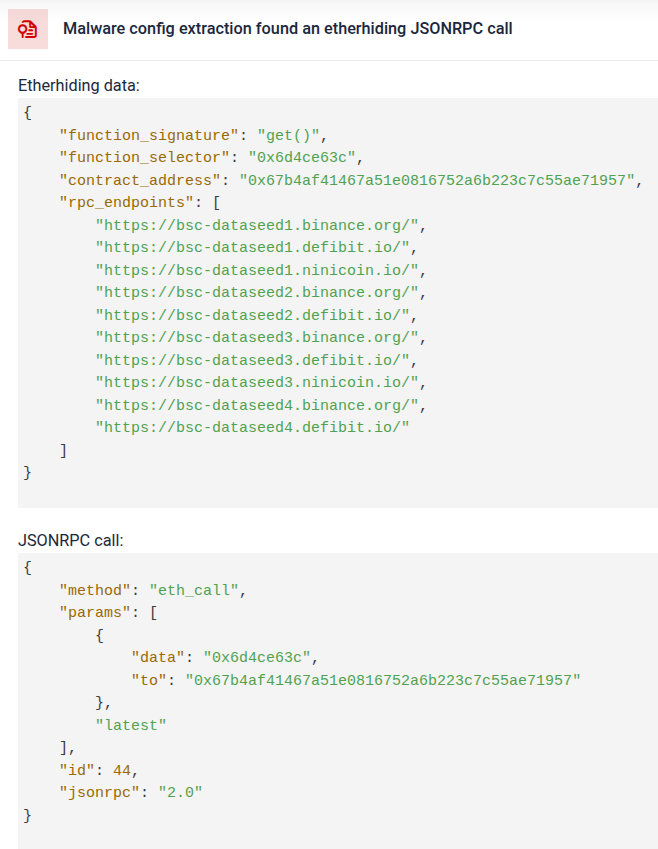
Mechanism: a read-only eth_call to get() (selector 0x6d4ce63c) on a minimal key-value-store contract.
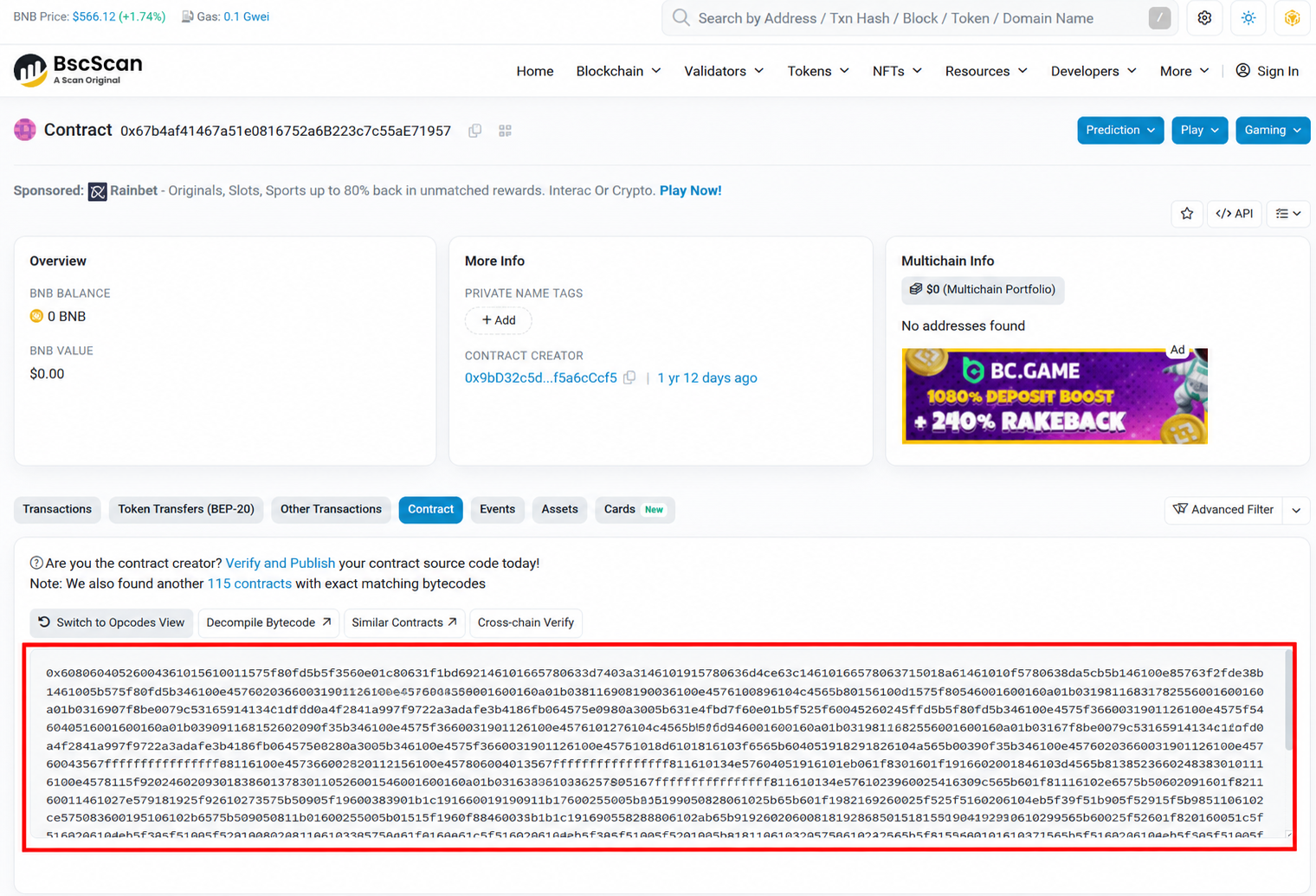
The operator writes new values via update(string) (selector 0x3d7403a3).
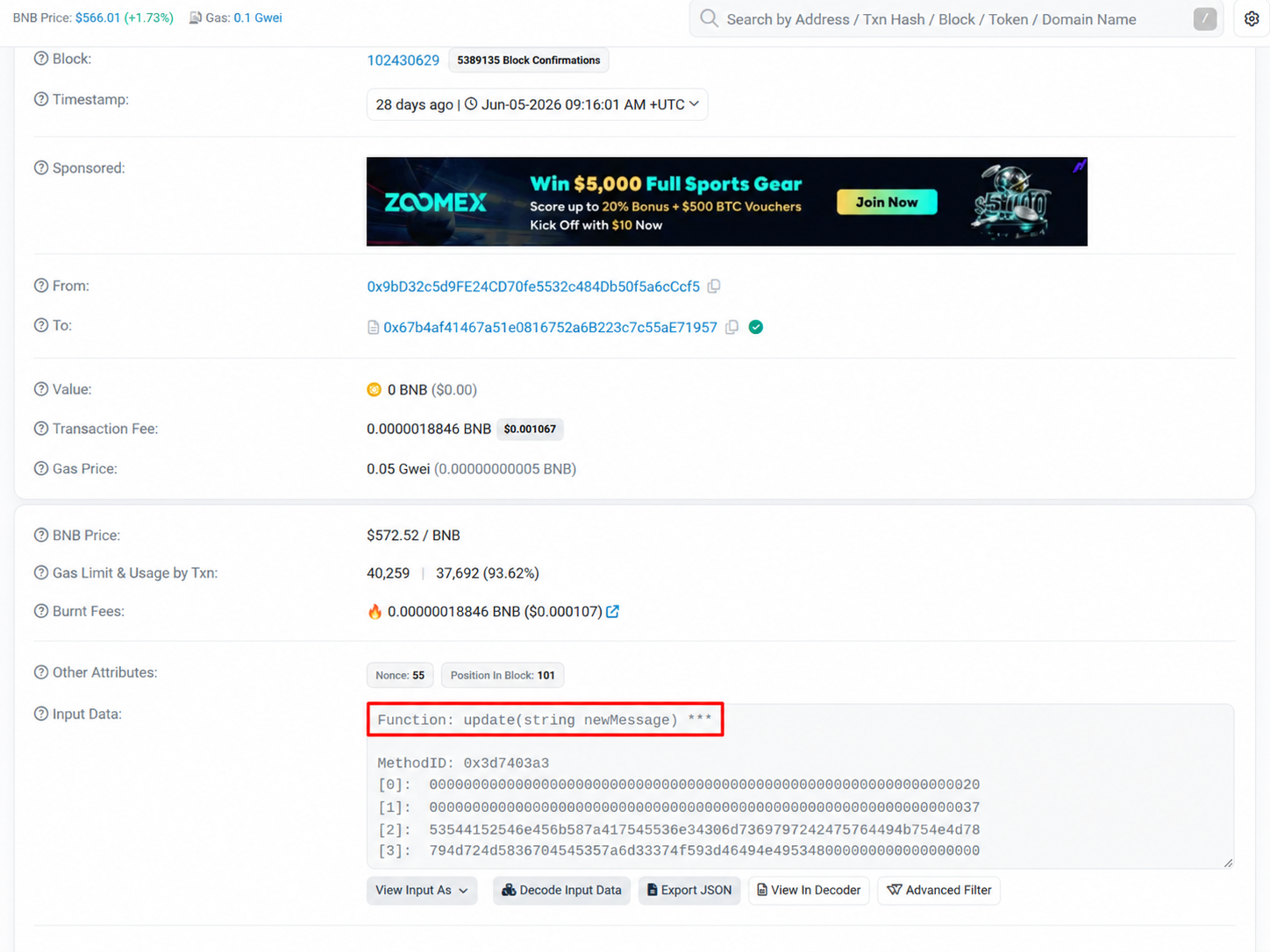
Because it’s a get() read call rather than an event log, there’s no on-chain event trail, only the operator’s own update() transactions are visible.
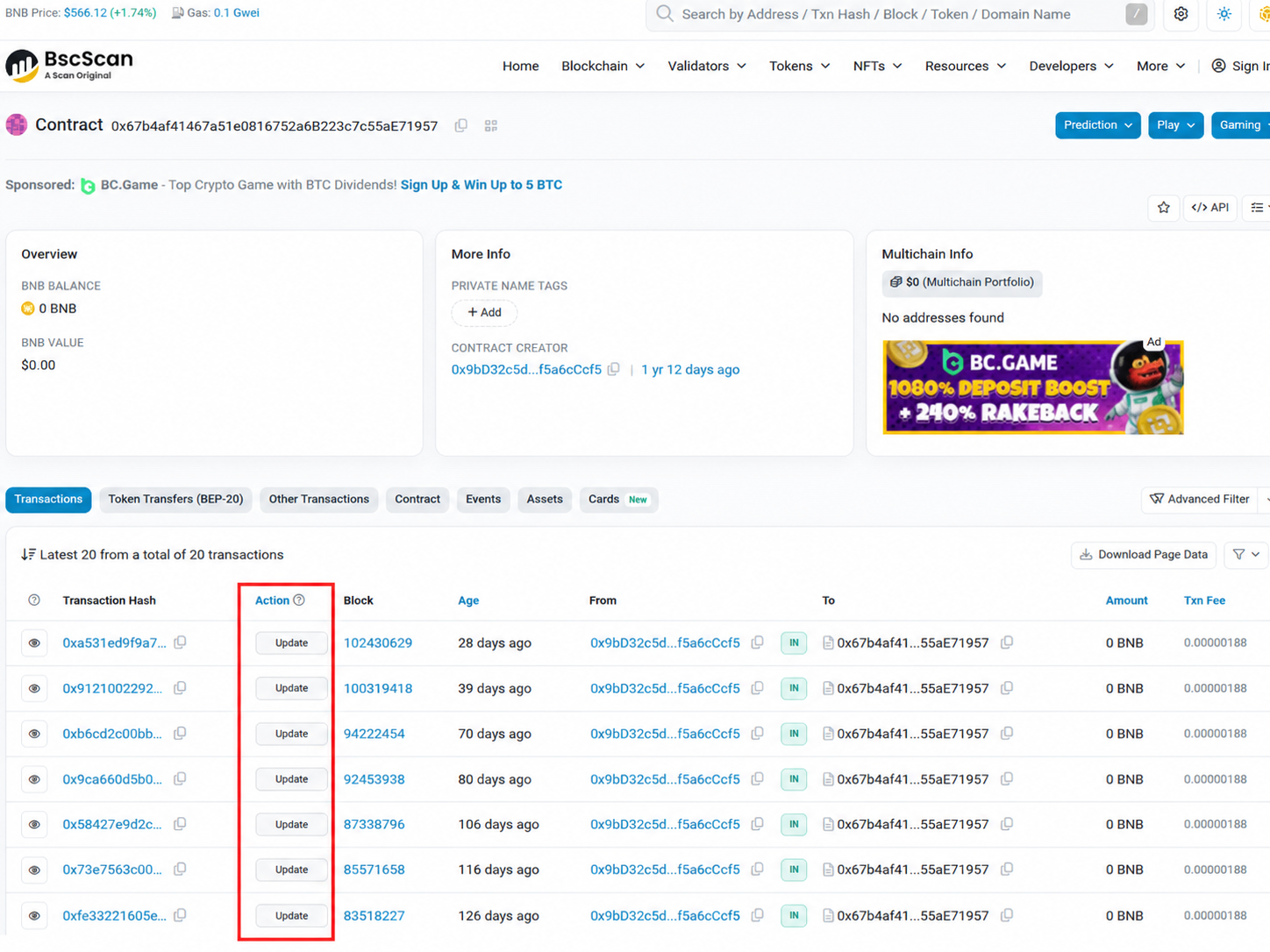
Contract A’s full C2 rotation history (2025-06-21 to 2026-06-05)
Contract A has 20 transactions total, all update() calls (the first, at deployment, sets the initial value, the rest are rotations). The AES-256-CBC scheme recovered above decrypts all with valid PKCS7 padding. The table below shows every write this contract has ever received, with the date, the tx hash value and the C2 decrypted value.
The tx hash is each transaction’s unique on-chain identifier (a 32-byte/64-hex-character digest of its contents).
| Date (UTC) | Tx hash | Decrypted value |
|---|---|---|
| 2025-06-21 08:51:13 | 0x7971eab99ea0f4248c061d8aba030d35dd64eb0f65a35e49deedde50121845c3 | 77.73.131[.]91 |
| 2025-12-04 15:22:03 | 0x0dd79ab017e4bdb70f82db2eb2bd11f392a4cd7a2eb9d751d89a71e52613d702 | 146.103.126[.]229 |
| 2025-12-04 20:17:02 | 0xa40e1eab97f2816800c8b7a34a7366c3cdbd2e776a347bb2a97ff250c98b46a9 | 146.103.126[.]229 |
| 2025-12-14 20:51:22 | 0x87fd8a8c605b8a9b5544d930b421d97a092afb1d3c7211fb3a883d0565f6c3af | 146.103.126[.]229 |
| 2026-01-17 15:37:40 | 0x130e5d7feedef14d6bf7e42e7013668502e01606a992cfd46f0f51ec1bf2d00b | 77.105.136[.]66 |
| 2026-02-04 08:16:22 | 0xe2d857ec877de5db84a969f28148e58e744cf2a92f77455db54f14412febacfb | 77.105.136[.]66 |
| 2026-02-19 10:20:54 | 0x7b10e5897d5653d8c0757a3b4456ca8e4a21c264179691754ae77a65ad7feacb | 77.105.136[.]66 |
| 2026-02-21 08:01:46 | 0x648c906303c49562f44cbbfd2209c58ec4862a507c5dc328420ab707dfeed1af | 77.105.136[.]66 |
| 2026-02-21 09:02:32 | 0xe8e11e410c33d1f0fdbaeb975343a105a2c56741d01b97a84734df9f6eb8dfe8 | 64.111.93[.]20 |
| 2026-02-21 09:21:45 | 0xe9e28d4a5eb74b4a34b0bb88ae77310b10017ec3fd8a807e9e0123e131fc033b | 77.105.136[.]66 |
| 2026-02-23 09:36:30 | 0x14b835f8d6e999ab263c1041bd8f602fb7fe8bc9cf2912c54b7f4a9931c6388a | 77.238.232[.]188 |
| 2026-02-25 17:25:08 | 0x68e27382b2a3e9ac8f997f0fc10b418a6df9d3c3804e9a2a2d1467935e656a1b | 77.105.139[.]80 |
| 2026-02-25 17:39:42 | 0xf12b64ba58a90411d0a7a0682af603afabe999a7e0df90326111cb4d86724703 | 179.61.145[.]140 |
| 2026-02-26 18:05:08 | 0xfe33221605e7afc077a51ba3ce118d28126ef7a8c2f4886b45f26ec8b9998c6d | 179.61.145[.]140 |
| 2026-03-09 10:50:02 | 0x73e7563c0030afa1fd5c85c01ec9d071e69af2bcedf6560fc3e3f6b58c9ef576 | 179.61.145[.]140 |
| 2026-03-18 16:22:43 | 0x58427e9d2cac96158265054c314f2ab1d15329c5229f0c87e039e70c199cbbc1 | 141.11.197[.]134 (the C2 from the analyzed sample) |
| 2026-04-14 08:23:41 | 0x9ca660d5b05dcec73e89f29b83551a8db9d7f4f745b807d8e9f99a050639313a | 141.11.197.63 |
| 2026-04-23 13:45:46 | 0xb6cd2c00bb5a60bca0d535ed1ed14723989bbbee27301527251707842909b35a | 185.112.59.99 |
| 2026-05-25 08:55:10 | 0x9121002292ad5fa6fb19b68cee5c74b09cf48e179166ed5f00427f9b62c98193 | 185.112.59.99 |
| 2026-06-05 09:16:01 | 0xa531ed9f9a7b15a7b7a9be07331790f10013cb9466db1cf9282cbbb40b829986 | 185.112.59.99 |
Ten distinct IPs, each held from a few days to several weeks before the operator rotated to the next one. The rotation cadence tightens noticeably from late February 2026 onward (several same-day and next-day updates around 2026-02-21 and 2026-02-25) before settling back into multi-week intervals.
The AES key does not generalize across the wider contract cluster
We looked for similar contracts and found 122 contracts with the exact same bytecode content (table in the IoCs section). Even though the bytecode template is shared across multiple contracts, most deployments are keyed independently, so we couldn’t decrypt the C2 from them. As mentioned before, finding samples that interact with these wallets would be a requirement to decrypt the C2, since the corresponding key is hardcoded among their protected strings.
Passive infrastructure check on the 10 rotated C2 IPs
The infrastructure analysis revealed that the rotation isn’t totally random, it concentrates on two hosting clusters.
| IP | Active period | ASN | Provider | RIR |
|---|---|---|---|---|
| 77.73.131[.]91 | 2025-06-21 | AS210644 | AEZA GROUP LLC | RIPE (block registered AE, AS home RU) |
| 146.103.126[.]229 | 2025-12-04 → 12-14 | AS216071 | VDSINA – SERVERS TECH FZCO | RIPE, AE |
| 77.105.136[.]66 | 2026-01-17 → 02-21 (recurring) | AS216071 | VDSINA – SERVERS TECH FZCO | RIPE, AE |
| 64.111.93[.]20 | 2026-02-21 (single day) | AS399629 | BL Networks (BLNWX) | ARIN, US |
| 77.238.232[.]188 | 2026-02-23 | AS216071 | VDSINA – SERVERS TECH FZCO | RIPE, AE |
| 77.105.139[.]80 | 2026-02-25 | AS216071 | VDSINA – SERVERS TECH FZCO | RIPE, AE |
| 179.61.145[.]140 | 2026-02-25 → 03-09 | AS202051 | NETGRID HOST LTD | RIPE, GB |
| 141.11.197[.]134 | 2026-03-18 | AS202051 | NETGRID HOST LTD | RIPE, GB |
| 141.11.197.63 | 2026-04-14 | AS202051 | NETGRID HOST LTD | RIPE, GB |
| 185.112.59.99 | 2026-04-23 → 06-05 (current) | AS209207 | DHOST-AS / Digital Hosting Provider LLC | RIPE, RU |
- Two ASNs account for 7 of the 10 rotations. AS216071 (VDSina) covers four IPs and AS202051 (NETGRID HOST LTD) covers the other three. The operator moved across three different /24 blocks (
179.61.145.0/24→141.11.197.0/24, twice) while staying on the same ASN throughout, from late February to mid-April 2026. - VDSina is registered under a UAE shell (Servers Tech FZCO) but operates as a Russian-market VPS brand. This is jurisdiction-layering, typical of gray/bulletproof hosting.
- NETGRID HOST LTD’s RIPE registration itself changed shortly before this campaign adopted it. The ASN’s registered country flipping to GB on 2026-01-23, about a month before the first rotation onto it (2026-02-25).
- The first and last providers in the timeline are both Russia-based (AEZA GROUP and DHOST). Of the 5 distinct ASNs used, 3 trace to Russian-operated hosting despite only one (DHOST) being RIPE-registered under RU directly.
64.111.93[.]20(BL Networks, ARIN/US) is the one outlier used for a single day sandwiched between two uses of the VDSina IP77.105.136[.]66on 2026-02-21 (08:01 → 09:02 → 09:21 UTC).
One of the IPs also appears in an (apparently) unrelated SectopRAT campaign
Checking the rotated IPs against public reporting, 179.61.145[.]140 turned up in a Rising Threat Intelligence report published on March 31, 2026. That research covers counterfeit adult-game installers impersonating the IndieGala platform, which chain an Advanced Installer package, MSI files and PowerShell Defender exclusions to deliver SectopRAT (a different family reaching victims through a different infection chain than the samples in this post).
The overlap goes past the IP itself. Rising reports the same resolver contract (0x67b4af41467a51e0816752a6b223c7c55ae71957), the same get() selector and the same six BSC RPC endpoints, with the contract acting as a fallback for when their sample’s hardcoded HTTPS C2 is unreachable. Their capture also falls inside the window our decrypted history assigns to that IP (2026-02-25 to 2026-03-09).
Plenty also separates the two, which is why we doubt they belong to the same campaign. The payloads are different families and the delivery differs. The obfuscation stacks have nothing in common either: our sample leans on ConfuserEx and a stripped import table, theirs on signed-binary abuse, Defender exclusions and a plain character-array trick to hide domain strings. The C2 designs differ too, since ours reads the contract as its only route to a C2 while theirs treats it as a fallback behind a hardcoded HTTPS endpoint. Rising’s AES key is unrelated to ours and protects a different channel, and their reconnaissance domains appear nowhere in our corpus.
Neither dataset tells us who operates what, but the scenario we find most probable is a shared infrastructure operation: one party runs Contract A and the resolver logic while separate payload families attach to it, either as products of the same operation or as customers of a rented C2 layer. The foundation for this theory is that both campaigns use the exact same deployed contract instance rather than just the EtherHiding technique, indicating a high-confidence technical relation between campaigns without revealing the exact relation. Deploying a fresh contract costs very little, so two unrelated developers building this independently would be expected to deploy their own independently. We can’t rule out other explanations, including a shared relay sitting in front of separate backends, or one actor simply reading the other’s dead drop, since the stored value is readable by anyone.
What this means for defenders
Blocking the C2 IP accomplishes little here. Contract A served ten different IPs over roughly a year without its own address ever changing, and the operator restores service with a single update() call that costs a few cents. The contract address is the part that stays fixed, so that is what detections and blocklists should pin to, along with the RPC endpoint set the sample uses to reach it.
That RPC traffic is itself a signal. An .NET executable issuing JSON-RPC POSTs to bsc-dataseed1.binance.org and its siblings is something few legitimate desktop applications would perform outside wallet and dApp software, and it does so before any C2 contact happens. Filescan flags this pattern through the MWCFG009 signal group for the same confuserEx variants as a strong indicator, and also flags potential JSON-RPC activity through S148 and U023 with lesser risk confidence level .
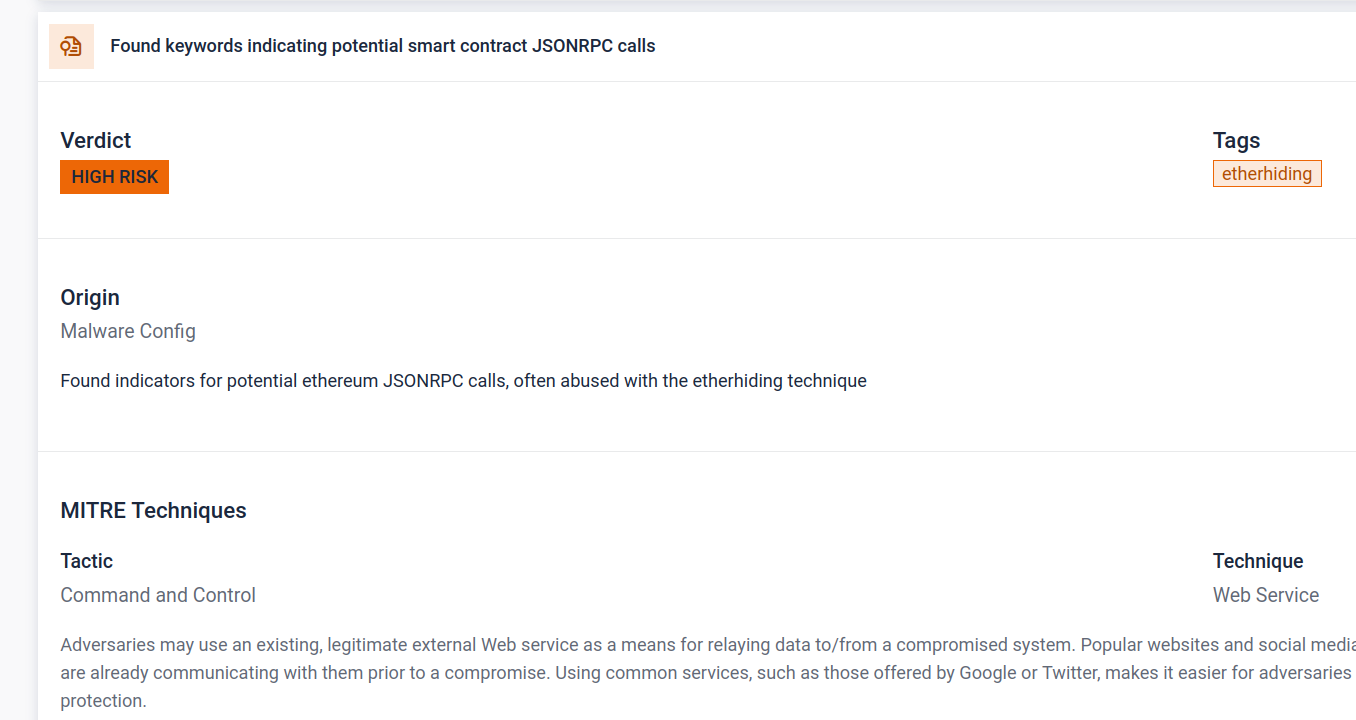
Back to the malware analysis, a sample that refuses to execute is not automatically a dud. All six samples in this cluster failed in traditional sandboxing, and the cause turned out to be a deliberately broken PE header rather than a corrupted download. Triage that discards non-executing .NET binaries would have dropped this entire cluster, including the finding of the AES key that opened up a year of C2 history.
The permanence that makes EtherHiding resistant to takedown also works against the operator. Once the key comes out of one sample, every write the contract has ever received becomes readable, including IPs rotated out months before that sample was built. For a defender that means retro-hunting: the ten IPs above can be checked against historical logs going back to June 2025.
What we don’t know
- How these six samples were delivered to victims. We found them through a Filescan.io corpus threat hunting for blockchain RPC strings rather than from a captured delivery chain, so the initial vector is unresolved.
- How the tampered PE is actually loaded in the victim’s system. The stripped import table implies a separate stager performing the reflective load, which we were unable to find.
- Whether AES keys are scoped per contract, per deployer wallet or per build. Contract A’s key decrypts nothing in the other 122 bytecode-identical contracts, which rules out one shared key across the cluster but doesn’t establish what the actual scheme is.
- What is the actual relationship (if any) between the operator behind Contract A and the SectopRAT campaign reading the same contract.
- The payload’s exact brand or version. Its data-contract model matches RedLine, and META Stealer is a near-identical rebrand that shares that same model, so we place this in the RedLine lineage without naming the specific product.
Indicators of Compromise
File hashes
| SHA-256 | Note |
|---|---|
5ead45bc83c4fee8955212a5d8fc987164b13d149f6752d463381dddc444c5bd | 2026-03-25, broken batch. AES key/scheme recovered from this sample |
662435300304f5b1a75e577909ce65e24e483763342aa2eecfb1486911969b35 | 2026-03-25, broken batch |
9ca461a4341c6de3091ec0e1d571ffdd257ad23632dccb13b7417c06ae245930 | 2026-03-25, broken batch |
956fc9515bab51ddf550bdec0be053dae8997043e3f9979244e95925788cf53c | 2026-03-25, broken batch |
1af5aad4a5f22146539a05ccae2a7a18cfe49ff9e9a6a1dbf10a9cde0bd0957f | 2026-03-21 |
2c1630f00a7903d2895e648571a5e302475ef1ca56daa862050ae298c06d0309 | 2026-03-21 |
BSC smart contracts and wallets
| Item | Value | Note |
|---|---|---|
| Contract A (EtherHiding resolver) | 0x67b4af41467a51e0816752a6b223c7c55ae71957 | At least 6 RedLine samples related |
| Operator wallet | 0x9bD32c5d9fe24cd70fe5532c484db50f5a6cCcf5 | Deployed and operates Contract A |
| Funding hub | 0x2a0d937DE7C5FAf3D6Bf5878f62A23D7BCEBB02b | Funds the operator wallet |
| Hub’s own funding source | 0xa6AB8B5120f72b9419d85731823f2338510D9410 | One hop up from the funding hub |
| Related contracts (bytecode-identical) | 122 addresses | See “Bytecode-identical contracts across the wider corpus” below |
Network and host artefacts: Contract A’s C2 rotation history (2025-06-21 to 2026-06-05)
| IP | Active period |
|---|---|
| 77.73.131[.]91 | 2025-06-21 |
| 146.103.126[.]229 | 2025-12-04 to 2025-12-14 |
| 77.105.136[.]66 | 2026-01-17 to 2026-02-21 |
| 64.111.93[.]20 | 2026-02-21 |
| 77.238.232[.]188 | 2026-02-23 |
| 77.105.139[.]80 | 2026-02-25 |
| 179.61.145[.]140 | 2026-02-25 to 2026-03-09 |
| 141.11.197[.]134 | 2026-03-18 |
| 141.11.197[.]63 | 2026-04-14 |
| 185.112.59[.]99 | 2026-04-23 to 2026-06-05 |
Cryptographic material
| Item | Value |
|---|---|
| AES-256 key (hex) | 16658a6e0b49091670fd18f189e1fe0cee27f824936ff6a07713a206eddc9436 |
| IV (hex) | 541dd0207d92c0e7d2c6138417559b2f |
| Recovered from | Sample 5ead45bc83c4fee8955212a5d8fc987164b13d149f6752d463381dddc444c5bd |
Bytecode-identical contracts across the wider corpus
| Contract Address |
|---|
0x00c98d4806ef6aef5accb5dae2bada9d160a9de6 |
0x04199f36a3432a7ab56d2b4b825ddbff4f6a8a30 |
0x07d8f3daad8936df2e44f13b50a48f7e6775f6c4 |
0x0dc18c881a46e37de9703c390535cdb285d37a16 |
0x0e34675cfe8faaafc6afa3ff99bf5f3013aa6ce6 |
0x100a051d2b55cee3f668e995ff34ed9fbc1edf75 |
0x101b51e7489a4ddc2b78e94c86736969e54b59da |
0x17359051ace963f847a879e6672b934f60dc6e52 |
0x17b2745b68dfc85a393f09587904a7bb06be228d |
0x1838ba721dc0f15ebfa9d50e1272b9ca257a3795 |
0x1913231be66becc0a0aa9c004ef7176db0e09289 |
0x1c2b2eb1e5087b442a1bb84aa935e4c753eba1e7 |
0x1e4c19db19a90e17960312720d4ccbd6b36f6764 |
0x1eb7a243e568948a72fc27cceb767fc2a58c67c0 |
0x201c6e502f54646beaeb9555f44391e107b92770 |
0x21f81da5a0d9013f0acd44d3e485ae5f32ba8939 |
0x25fa1a0fe5d6b1db4596691f31fa26ef95e8db32 |
0x28c720242e6ab635212988fa1412f5799bacc5f3 |
0x2928d637cdc20a1c0aed8df815f5f9f49052a5b8 |
0x2a1abae855fb6adab2d4fdd1b298a7e710fe86b5 |
0x2da2244555c222380120d65a29d19f8acc84f67f |
0x2e037e82f42c9c03061716bba28308a7209a2002 |
0x2e80c30270e27cee7cd38ddabc56bf17428e8170 |
0x2ee33ebf104b200254f97f386445dcb95c034294 |
0x2fda3bf64ea33eee8855e4766a61183823ae7cde |
0x31b276309fae3b11ee10ad085e165217092894cd |
0x330471e2491ca46842787002b99966e5cb4e02c3 |
0x335a7a4f127572a51b30bab41184e1c2bcb1c263 |
0x347dea3e6bc002de30af4507f93edc162f27ffb9 |
0x35697b68a524864b2f22be80253980b21fcbdb0e |
0x38b513cf891ea40606ff40a2810834cfc2f43b9c |
0x3902b0e553b29d9549728c3f943211bf122fb0cf |
0x39b4b46c217326507960e1f2727ebb463cfdf905 |
0x3b7ceda3e3969a59c7943b3335d602ba1a5c77ca |
0x3c2a189c13e50dc754ec735b0a89a887ee74b3c2 |
0x3cdcac046aecbb48b60aad7d2420be6998297409 |
0x41e91c575b3eba3cc0c18bb85464c282ae705d59 |
0x42c60520ded9ea0e59263529ae6a19491588df6b |
0x4c27e37d835ccdd43558e03a95d4308a1308c041 |
0x4d12cffca41a212086f3d43bb37db32393eeb8bb |
0x509fb3017546385c469fa877c3505b7dbbfb620c |
0x556bd2a8732b5994f887f60dcf9e3f8b75c96c5f |
0x57162e70b6456d93be8820f58473703ce3823979 |
0x584bd5cee8dac78d8cd70a1918e1c7e2bc3b4c4a |
0x59148e090e021b726858da0ca03bbccd68e40b17 |
0x5d783525f2a582bbc06fcd1406970fe31f883339 |
0x61b7b361cdf38d40e7d91c43028c62de4f30998c |
0x63b08416c66c6ed85732adb2b2be334af265c2cb |
0x69a7f39952f3d65605c3edda0f5a6712f07a5184 |
0x6b134a1ccdd585d760142d808a30d963ee14dbee |
0x6b4998926b651fee1cec07ae3aed813437ec9f76 |
0x6dec0d19e610517c97ed418bff89ff0081d6a719 |
0x7053b9dcc5608389260174551e7982eb30a875d1 |
0x70a9aee14d5357be740ae091bff100a3a246fe2a |
0x7264c2b7bad4f9d7228243b55df1c6e53a13660b |
0x7362c5844820dfed44f41e6206ac5301e39eb303 |
0x7440b16afbf9a871914471655a10721f56e87253 |
0x761392af8c9ae920838b84216c4dc3900320b912 |
0x7818fb09d9eb1a74888a0a33223c2fb30c93a052 |
0x7a61b3694157dfc0a0bcb1cbc93e1775be2bdc12 |
0x7cad4221db006105ef4039b373837761938575b1 |
0x833978e647f171f32217177f3f66a416c106717b |
0x83862d8fbfcf4001c9439a59d14e5dca36ad5bba |
0x8b43d3d3f4b91dbe7a4512ec90dc82577d125c34 |
0x8c744bd54640650c8885975032b5e54321da283b |
0x8cb39206eda90ac81e7d71358e2cf1327214ccaf |
0x8cdd792abb0d30fcb7929e860fa57e09918abdf9 |
0x8d278f6e0f126c3d901d5cb9ecc6e22754a1fea6 |
0x8e28c9b2ecfbb1b189c5189bf111e4b0b38243e8 |
0x8e2b9e3262e86c65db892e8992070d0455c57a22 |
0x8ec9363206195b3f98eb655fbc402520be6b910d |
0x90d42158d35eddd437a0407a0ffe5fb28c47e30d |
0x9314eea7117aa39e0abd84a40301b038a2de7af4 |
0x931f16e4f731d4f6a12035dffce7d395fd0712f2 |
0x94db8d4e2aa1abfb94f247da449ebf3e932abb2a |
0x96c4e67620f0a80d08cb1948d4bdb6049d4394c5 |
0x99322a70fe3c1aba78268e69e5c5b650f80cc4bd |
0x9bb2eef8ce08dc5a5423ed9accbb351c1facf624 |
0x9f9175c4d396047b7a2794b483553dc3e124ac80 |
0xa125cc4da21895aa45ebe39446fea15dfafbf467 |
0xa32e29d6c00b4b700c653a0070ee57c4e3ca5c64 |
0xa602c36dc0235be52be5cf06682fdf6333dbf883 |
0xaf9bafb2198b700c20bc62f732bb136dcb3604a2 |
0xafe90e92a74c7963fbbdb0c888d42010fbfbcf6e |
0xb1e2bd333e04bb1c29aae8f45dafb93ec3f5e0fe |
0xb45155040dd8861a004a8a3424175952e2df61b9 |
0xb666c040c6d218057cbf46e09ad84e9a806f6952 |
0xb92314539acf35df1132490b8b1d73680627be60 |
0xba43595984d43941729aa3e604e30a229575aa34 |
0xbd75e2f339d4aebf72ff13f3af4c27096f709a4d |
0xbf81f1955e2e7e3b04ea7c82b72bbf6853191e32 |
0xc1434e93b16b61359583a21a28ab911cdbe4e380 |
0xc29aa2f12d8d0a03ed225ac4f235d650e0ab02d3 |
0xc35d40c5c35eb33438078f16ba92a2f78c8bfb62 |
0xc5980eb3bbd7d6f829f046f07cf195c72a1c3f29 |
0xc697d8019602d173ce4bbde323b86a08ab6674ac |
0xc8da5056e06993926e29efc55ed86681d282df8f |
0xc993ceb5c06d0191e3c681707980f3d3d00d8e67 |
0xc9b44479ce3797ee5a5602f1565eaad913a0adc3 |
0xcdb5e2d4a7cc9cb8054e90777b3d9875807fbac1 |
0xcfa52dd7dc11dd64e276993cb503030e722898e6 |
0xd46c4b5cf4e9f784dae2ee4472ccafa7fd0f94d5 |
0xd5b7e4cc132986426f5409f42799d0e1d0f44b62 |
0xdd31210b5b128fe7adc0298d5c6a6db2c7277c46 |
0xde9095a75a667557f718f6c6ea063baef4fad93a |
0xe012d0f34cde9b870e9d9ed566ea5f8fd9b92228 |
0xe23a36e194d4a439b56a2e09a67dca2fe981af73 |
0xe7169089bb0665b430990932e364d69e1bed804e |
0xe73ce4a3538eb29502a103aa36e5b9b2049d4f6a |
0xe858a0c67ee580ed0b9f15c98d59265281999873 |
0xefc52801004e57db8545353e5bcbe8d3e4339e84 |
0xf1eb005811dccff35cfb0059ccded47ce22b78e8 |
0xf2431a8333a67026d91dbc322ca4073ccd51d426 |
0xf4852d108394a87c5a595d522683be586cf0cb4f |
0xf68f23f721e835cc6a3dd541bb4768d001380a7b |
0xf739182dc2d44d957052a873b664f19a71f693da |
0xf7963a7bfc9808501c72904f31c78eb85a94bf1a |
0xfa624ded1acf74810a7344efc0b8d2a7369fd886 |
0xfae0d1c011c6d510f05fc8de9af55f2d3cb945e6 |
0xfc231353d9414b783832c2c2f94208b2e889fc9a |
0xfdf3acb71c52889e5bb38e77512a7a18d292fe10 |
0xfef59420b204fbf6ca12e9d08b1c54b07c55c7ab |
Sources
- Guardio Labs, “EtherHiding — Hiding Web2 Malicious Code in Web3 Smart Contracts”, October 2023
- Xinhao Zhao, “Desire and Risk: Exploring the Dual Nature Behind Adult Game Counterfeit Installation Packages”, Rising Threat Intelligence Platform, March 2026